


The Q3 2026 CBAM Certificate Price Is €82.32/tCO₂. But That Is Not Your Customer’s CBAM Cost
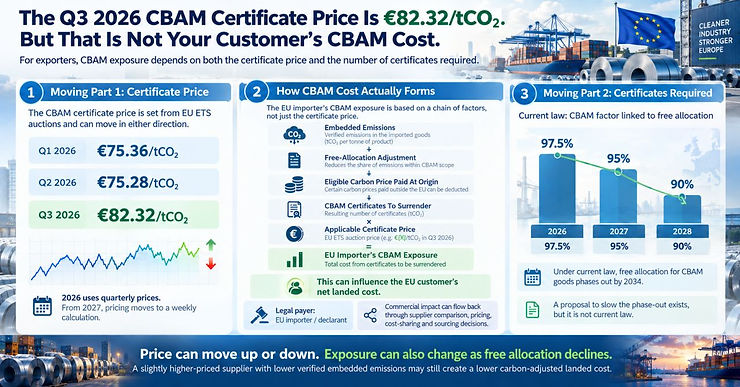
The European Commission has published the Q3 2026 CBAM certificate price at €82.32/tCO₂.
For exporters, that matters. But simply multiplying embedded emissions by €82.32 and calling the result “the CBAM cost” can be misleading.
The legal obligation to purchase and surrender CBAM certificates sits with the authorised EU CBAM declarant. The commercial impact, however, can travel back through the supply chain through supplier comparison, price negotiation, CBAM-cost sharing and sourcing decisions.
The cost chain is closer to:
𝗘𝗺𝗯𝗲𝗱𝗱𝗲𝗱 𝗘𝗺𝗶𝘀𝘀𝗶𝗼𝗻𝘀
→ Free-allocation adjustment
→ Eligible reduction for carbon price effectively paid at origin
→ CBAM certificates to surrender
× Applicable certificate price
= EU importer’s CBAM exposure
For exporters, that can ultimately affect the customer’s net landed cost.
CBAM exposure has two moving parts.
First, the certificate price can change. For 2026, it is calculated quarterly from the weighted average of EU ETS auction clearing prices. Q1 was €75.36/tCO₂, Q2 €75.28/tCO₂, and Q3 is now €82.32/tCO₂. Each quarterly price applies to imports from that quarter. From 2027, pricing moves to a weekly calculation.
Second, the number of certificates required can also change over time.
Under current EU law, the CBAM factor linked to EU ETS free allocation falls from 97.5% in 2026 → 95% in 2027 → 90% in 2028, with free allocation for CBAM goods scheduled to phase out by 2034.
So even if the EU ETS price were unchanged, CBAM exposure need not remain unchanged as the free-allocation adjustment declines.
But I would not say “CBAM prices will keep increasing.”
We do not know that. CBAM certificate prices follow the EU ETS market and can move in either direction.
There is also regulatory uncertainty: the European Commission has proposed slowing the free-allocation phase-out from 2028 and extending it to 2038. That proposal is not current law.
For exporters, therefore, the commercial question is no longer only:
“What is our emissions number?”
It is:
“What does our carbon intensity do to our EU customer’s net landed cost — relative to another supplier?”
A slightly higher-priced supplier with lower verified embedded emissions may, in some circumstances, create a lower carbon-adjusted landed cost.
That is where CBAM moves from compliance into pricing, customer strategy and competitiveness.
On 7 October, Smart Tradzt Managing Director CK Chung will join Star Consulting Vietnam to discuss these topics as part of our practical CBAM 2026 webinar.
Registration link: https://lnkd.in/dNf9RxQB