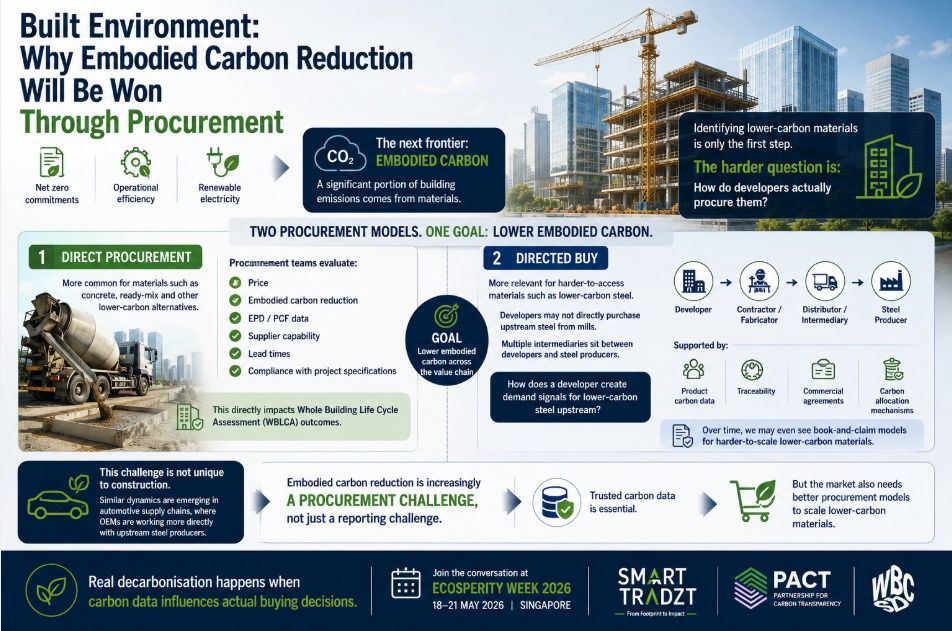
Many real estate developers now have net zero commitments.
Many are improving operational efficiency.
Many are buying renewable electricity.
But one of the biggest decarbonisation challenges is becoming harder to ignore:
embodied carbon.
For many buildings, a significant portion of lifecycle emissions comes from materials such as:
- Steel
- Concrete
- Aluminium
- Glass
And this is where many sustainability strategies hit a wall.
Because identifying lower-carbon materials is only the first step.
The harder question is:
𝗛𝗼𝘄 𝗱𝗼 𝗱𝗲𝘃𝗲𝗹𝗼𝗽𝗲𝗿𝘀 𝗮𝗰𝘁𝘂𝗮𝗹𝗹𝘆 𝗽𝗿𝗼𝗰𝘂𝗿𝗲 𝘁𝗵𝗲𝗺?
There are typically two different procurement models emerging:
1. 𝗗𝗶𝗿𝗲𝗰𝘁 𝗣𝗿𝗼𝗰𝘂𝗿𝗲𝗺𝗲𝗻𝘁
- This is more common when developers procure materials such as:
- Concrete
- Ready-mix materials
- Lower-carbon alternatives directly through existing supplier channels
Procurement teams may evaluate:
✔ price
✔ embodied carbon reduction
✔ EPD / PCF data
✔ supplier capability
✔ lead times
✔ compliance with project specifications
This directly impacts Whole Building Life Cycle Assessment (WBLCA) outcomes.
2. 𝗗𝗶𝗿𝗲𝗰𝘁𝗲𝗱 𝗕𝘂𝘆
This becomes more relevant for harder-to-access materials such as lower-carbon steel.
In many projects:
developers may not directly purchase upstream steel from mills.
Instead:
fabricators, contractors, distributors and intermediaries sit between developers and material producers.
This creates a challenge:
How does a developer create demand signals for lower-carbon steel upstream?
This is where directed buy models may emerge:
Developer
→ contractor/fabricator
→ steel producer
supported by:
- Product carbon data
- Traceability
- Commercial agreements
- Carbon allocation mechanisms
And over time, we may even see:
𝗕𝗼𝗼𝗸-𝗮𝗻𝗱-𝗖𝗹𝗮𝗶𝗺 𝗠𝗼𝗱𝗲𝗹𝘀
for harder-to-scale lower-carbon materials.
This challenge is not unique to construction.
We are seeing similar dynamics emerge in automotive supply chains where OEMs are working more directly with upstream steel producers.
This is why embodied carbon reduction is increasingly becoming:
𝗔 𝗣𝗿𝗼𝗰𝘂𝗿𝗲𝗺𝗲𝗻𝘁 𝗖𝗵𝗮𝗹𝗹𝗲𝗻𝗴𝗲
not just a reporting challenge.
And why trusted carbon data alone is not enough.
The market also needs better procurement models to scale lower-carbon materials.
This is one of the topics we look forward to discussing during Ecosperity Week Singapore alongside PACT.
Because real decarbonisation happens when carbon data influences actual buying decisions.
#EcosperityWeek hashtag#EmbodiedCarbon hashtag#Construction hashtag#GreenProcurement hashtag#WBLCA hashtag#Scope3 hashtag#Steel hashtag#SteelIndustry hashtag#Concrete hashtag#Cement hashtag#Aluminium hashtag#Decarbonisation hashtag#SupplyChain