In my previous article, I suggested that industrial decarbonisation does not scale through technology alone.
That raises an important question:
𝗜𝗳 𝘁𝗲𝗰𝗵𝗻𝗼𝗹𝗼𝗴𝘆 𝗶𝘀 𝗻𝗼𝘁 𝗲𝗻𝗼𝘂𝗴𝗵, 𝘄𝗵𝗮𝘁 𝗲𝗹𝘀𝗲 𝗶𝘀 𝗿𝗲𝗾𝘂𝗶𝗿𝗲𝗱?
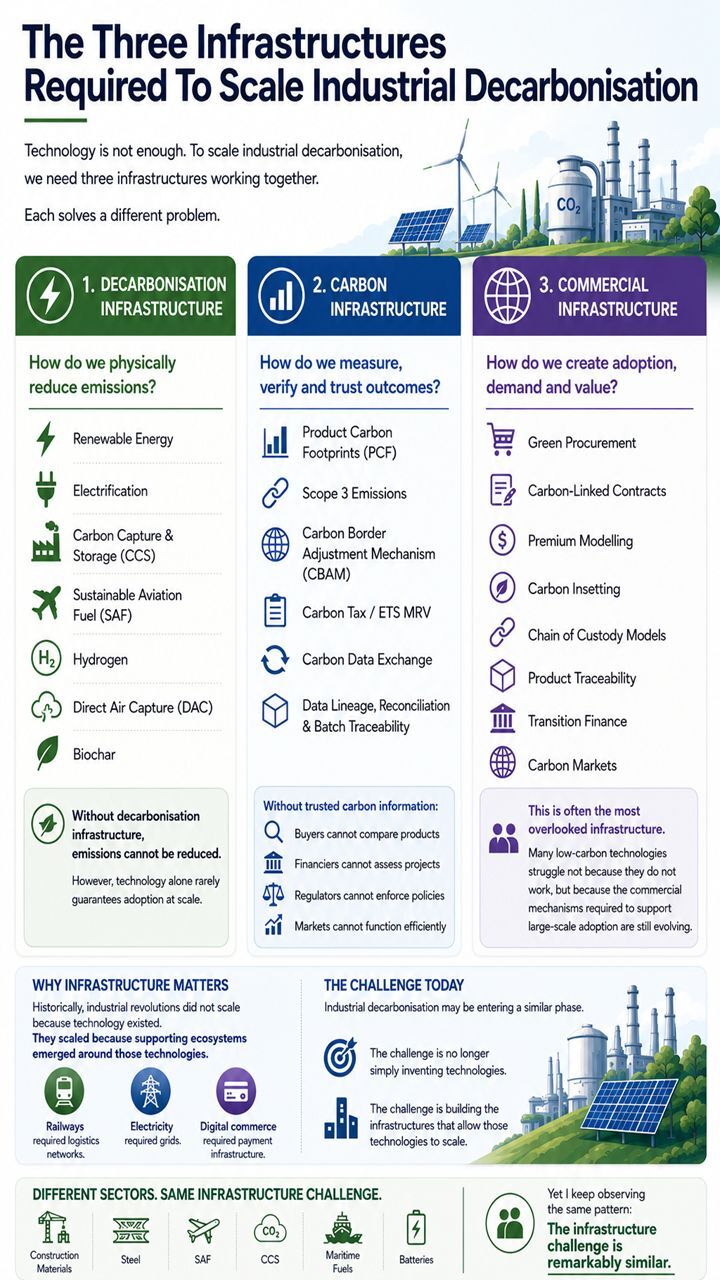
Across sectors including steel, construction, aviation, maritime, energy and manufacturing, I increasingly believe that three infrastructures are required to scale industrial decarbonisation.
⚡𝗗𝗲𝗰𝗮𝗿𝗯𝗼𝗻𝗶𝘀𝗮𝘁𝗶𝗼𝗻 𝗜𝗻𝗳𝗿𝗮𝘀𝘁𝗿𝘂𝗰𝘁𝘂𝗿𝗲
𝗛𝗼𝘄 𝗱𝗼 𝘄𝗲 𝗽𝗵𝘆𝘀𝗶𝗰𝗮𝗹𝗹𝘆 𝗿𝗲𝗱𝘂𝗰𝗲 𝗲𝗺𝗶𝘀𝘀𝗶𝗼𝗻𝘀?
Examples:
⚡ Renewable Energy
🔌 Electrification
🏭 Carbon Capture & Storage (CCS)
✈️ Sustainable Aviation Fuel (SAF)
💨 Hydrogen
🌎 Direct Air Capture (DAC)
🌱 Biochar
Without decarbonisation infrastructure, emissions cannot be reduced.
📊 𝗖𝗮𝗿𝗯𝗼𝗻 𝗜𝗻𝗳𝗿𝗮𝘀𝘁𝗿𝘂𝗰𝘁𝘂𝗿𝗲
𝗛𝗼𝘄 𝗱𝗼 𝘄𝗲 𝗺𝗲𝗮𝘀𝘂𝗿𝗲, 𝘃𝗲𝗿𝗶𝗳𝘆 𝗮𝗻𝗱 𝘁𝗿𝘂𝘀𝘁 𝗼𝘂𝘁𝗰𝗼𝗺𝗲𝘀?
📊 Product Carbon Footprints (PCF)
🔗 Scope 3 Emissions
🌍 Carbon Border Adjustment Mechanism (CBAM)
📋 Carbon Tax / ETS MRV
🔄 Carbon Data Exchange
📦 Data Lineage, Reconciliation & Batch Traceability
Without trusted carbon information:
🔍 Buyers cannot compare products
🏦 Financiers cannot assess projects
⚖️ Regulators cannot enforce policies
📈 Markets cannot function efficiently
🌐 𝗖𝗼𝗺𝗺𝗲𝗿𝗰𝗶𝗮𝗹 𝗜𝗻𝗳𝗿𝗮𝘀𝘁𝗿𝘂𝗰𝘁𝘂𝗿𝗲
𝗛𝗼𝘄 𝗱𝗼 𝘄𝗲 𝗰𝗿𝗲𝗮𝘁𝗲 𝗮𝗱𝗼𝗽𝘁𝗶𝗼𝗻, 𝗱𝗲𝗺𝗮𝗻𝗱 𝗮𝗻𝗱 𝘃𝗮𝗹𝘂𝗲?
Examples:
🛒 Green Procurement
📝 Carbon-Linked Contracts
💰 Premium Modelling
♻️ Carbon Insetting
🔄 Chain of Custody Models
📦 Product Traceability
🏦 Transition Finance
🌐 Carbon Markets
This is often the most overlooked infrastructure.
Many low-carbon technologies struggle not because they do not work, but because the commercial mechanisms required to support large-scale adoption are still evolving.
Historically, industrial revolutions did not scale because technology existed.
🚂 Railways required logistics networks.
⚡ Electricity required grids.
💳 Digital commerce required payment infrastructure.
Industrial decarbonisation may be entering a similar phase.
The challenge is no longer simply inventing technologies.
The challenge is building the infrastructures that allow those technologies to scale.
The sectors may be different:
🏗️ Construction Materials
🏭 Steel
✈️ SAF
🌫️ CCS
🚢 Maritime Fuels
🔋 Batteries
Yet I keep observing the same pattern:
𝗧𝗵𝗲 𝗶𝗻𝗳𝗿𝗮𝘀𝘁𝗿𝘂𝗰𝘁𝘂𝗿𝗲 𝗰𝗵𝗮𝗹𝗹𝗲𝗻𝗴𝗲 𝗶𝘀 𝗿𝗲𝗺𝗮𝗿𝗸𝗮𝗯𝗹𝘆 𝘀𝗶𝗺𝗶𝗹𝗮𝗿.
In my next article, I will explore why seemingly unrelated industries keep running into the same scaling problem.
#IndustrialDecarbonisation hashtag#NetZero hashtag#CCS hashtag#SAF hashtag#CarbonMarkets hashtag#TransitionFinance hashtag#EnergyTransition hashtag#IndustrialTransformation hashtag#CarbonAccounting hashtag#CBAM hashtag#Scope3 hashtag#PCF hashtag#CarbonTax hashtag#ETS hashtag#EPD