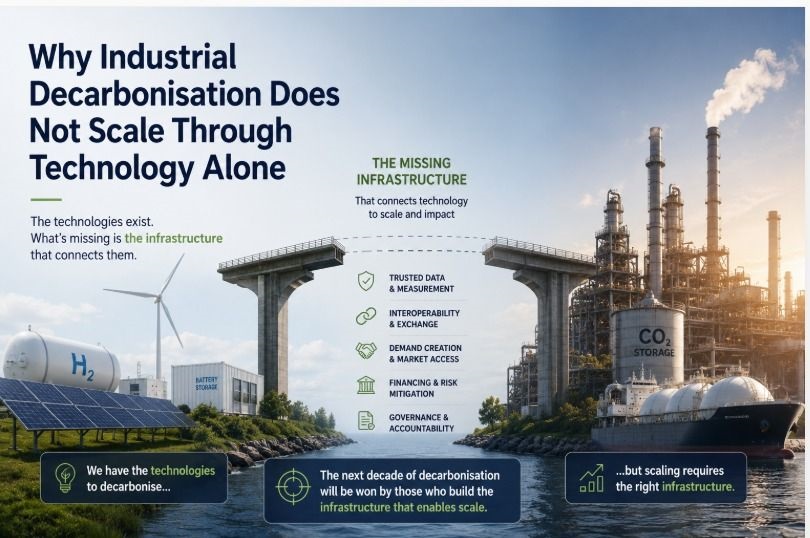
For the past decade, much of the decarbonisation discussion has focused on technology.
- Solar
- Wind
- Hydrogen
- Sustainable Aviation Fuel (SAF)
- Carbon Capture and Storage (CCS)
- Battery technologies
- Low-carbon steel
And to be fair, tremendous progress has been made.
Technologies have matured.
Costs have declined.
Policies have emerged.
Investment has increased.
Yet many industries still struggle to scale decarbonisation.
Why?
I am increasingly convinced that the biggest challenge is no longer technology alone.
It is infrastructure.
A steel producer may be capable of producing lower-carbon steel. Yet adoption remains limited if customers cannot easily identify, procure and justify paying for lower-carbon materials.
A SAF producer may be capable of producing sustainable fuel. Yet scaling remains challenging if demand, environmental attributes, pricing mechanisms and financing are not effectively connected.
A CCS project may successfully capture and store carbon. Yet commercial viability depends on how carbon reductions are measured, allocated, monetised and trusted across value chains.
In many cases, the technology already exists.
What is often missing is the infrastructure that enables markets to function efficiently around those technologies.
Historically, industries scaled because supporting infrastructure emerged around them.
Electricity required grids.
Global trade required ports and logistics networks.
Digital commerce required payment systems and digital platforms.
Industrial decarbonisation may be entering a similar stage.
Over the past few months, I have engaged with stakeholders across steel, construction, maritime, aviation, energy and manufacturing.
Although the industries are different, I keep observing a similar pattern.
The challenge is rarely confined to technology.
Instead, organisations are grappling with questions such as:
- How do we measure carbon consistently?
- How do we exchange trusted carbon information across supply chains?
- How do we create demand for lower-carbon products?
- How do we allocate environmental attributes fairly?
- How do we support financing and investment decisions?
- How do we create confidence for buyers, sellers and regulators?
These are infrastructure questions.
Not technology questions.
I believe this will become a defining theme of industrial transformation over the coming decade.
In the coming weeks, I will share perspectives on the types of infrastructure required to scale industrial decarbonisation, drawing on observations across steel, SAF, CCS, maritime fuels and construction materials.
But technology alone may not be enough.
The next challenge may be building the infrastructure that enables decarbonisation at scale.
#Decarbonisation hashtag#IndustrialTransformation hashtag#NetZero hashtag#SAF hashtag#CCS hashtag#GreenSteel hashtag#EnergyTransition hashtag#Sustainability